
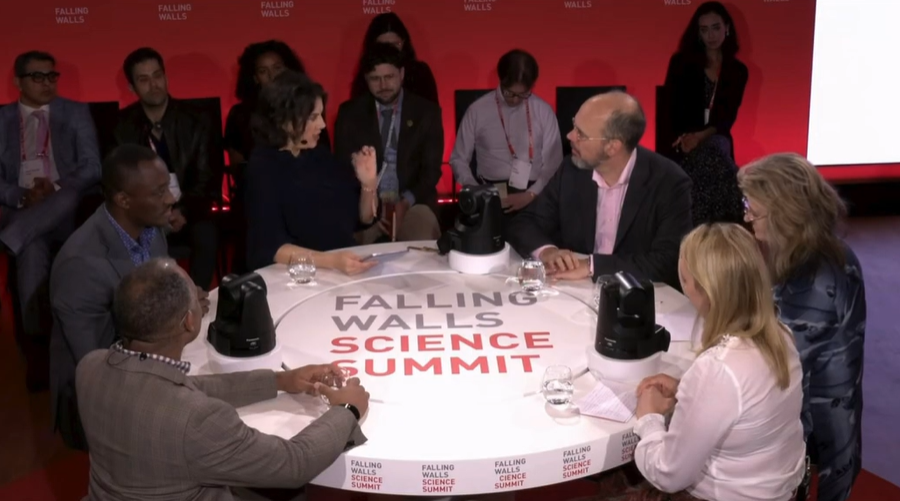
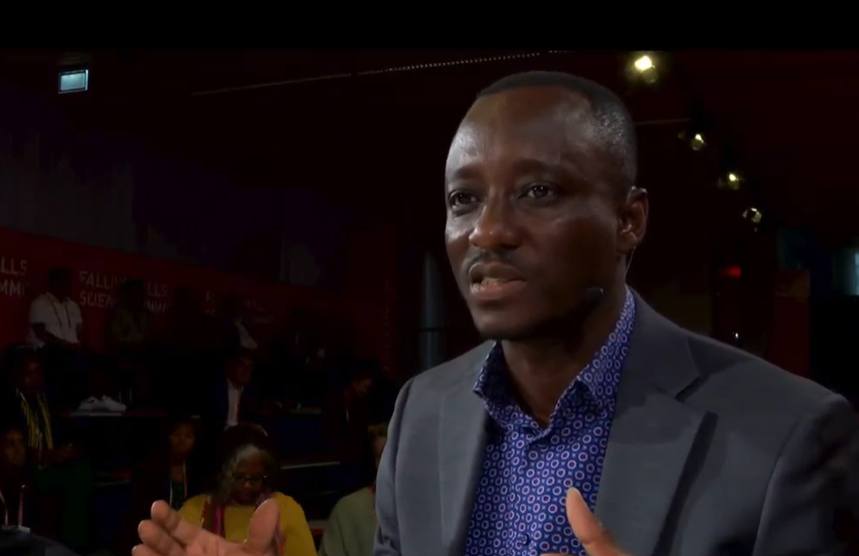
Dr. Prince K. Osei, President of the African Institute for Mathematical Sciences (AIMS) Ghana and Lead Scientist at Quantum Leap Africa, participated in the Falling Walls Science Summit 2026, contributing to a high-level Plenary Table discussion on the role of science diplomacy in advancing Africa’s position in global energy, technology and supply chains.
The Falling Walls Summit is a global platform connecting science, business and society to explore groundbreaking ideas and discoveries that address humanity’s most pressing challenges. Through its Plenary Tables, the Summit brings together leading international experts to examine how science, research and innovation can contribute to global development and create opportunities for collaboration across borders and disciplines.
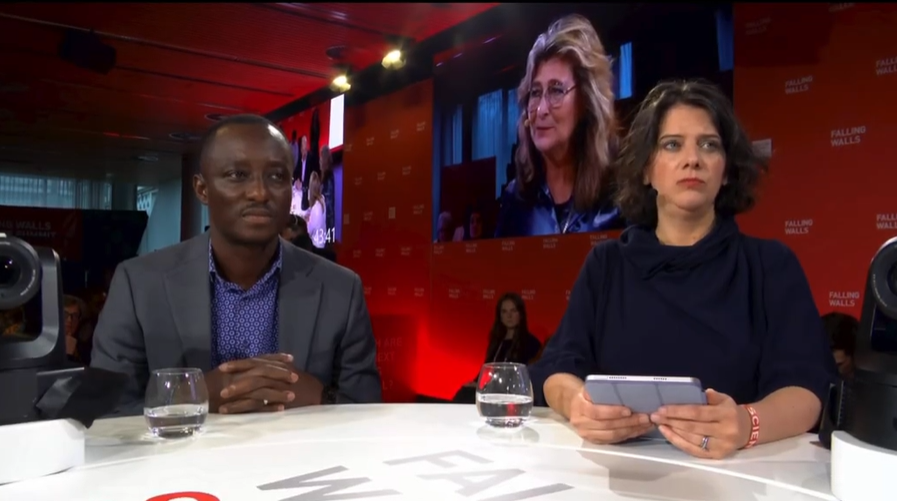
Dr. Osei participated in a discussion on how science diplomacy can strengthen trust, facilitate technology access and promote shared ownership of knowledge, innovation and value creation. The session was moderated by Jennifer Porto of New York University, United States, with contributions from Brando Okolo of the African Union Development Agency (AUDA-NEPAD), South Africa; Professor Tommaso Calarco of Forschungszentrum Jülich, Germany; and Professor Lise Korsten of The African Academy of Sciences, Kenya.
Addressing what traditional science diplomacy often lacks, Dr Osei emphasised the need to move beyond cooperation towards co-creation. He argued that international scientific partnerships should ensure that African institutions and researchers are not merely participants but active contributors to shaping research priorities, developing solutions and creating value from scientific discoveries.
He identified the gap between Africa’s scientific potential and the opportunities available to young people as a significant barrier to translating the continent’s abundant resources into local prosperity. While Africa has a growing pool of talented young people, many lack access to the opportunities and resources needed to develop and apply their capabilities. He therefore called for deliberate investment in building scientific capacity and creating pathways for young Africans to contribute meaningfully to research, technology and innovation.
On the question of building trust in science diplomacy, Dr Osei highlighted co-creation and openness in science, research and innovation as essential foundations. He noted that trust must extend beyond relationships among scientists to include policymakers and other stakeholders, particularly as emerging technologies introduce new considerations around access, regulation and security. Science diplomacy, he suggested, has an important role in navigating these complexities and sustaining productive international partnerships.
Drawing on his expertise in quantum science and technology, Dr Osei also highlighted the opportunities quantum computing presents for strengthening Africa-Europe research and innovation partnerships. He pointed to the potential of combining European research infrastructure and technical expertise with Africa’s growing pool of young scientific talent and innovation. Such partnerships could support efforts to address complex challenges in quantum computing while generating innovations with applications across different sectors and communities.
Dr. Osei further called for increased domestic investment in science and research, challenging the assumption that scientific development in Africa must depend primarily on funding from Western partners. He emphasised the need for African governments to prioritise investment in science as a critical driver of economic development, healthcare and solutions to broader societal challenges.
Reflecting on the next steps towards unlocking Africa’s resource potential, he underscored the importance of addressing the continent’s capacity gap. With Africa expected to account for a substantial share of the world’s young population and future workforce, he stressed that providing young people with the necessary training, resources and opportunities will be critical to the continent’s ability to participate in and benefit from global scientific and technological advancement.
 English