
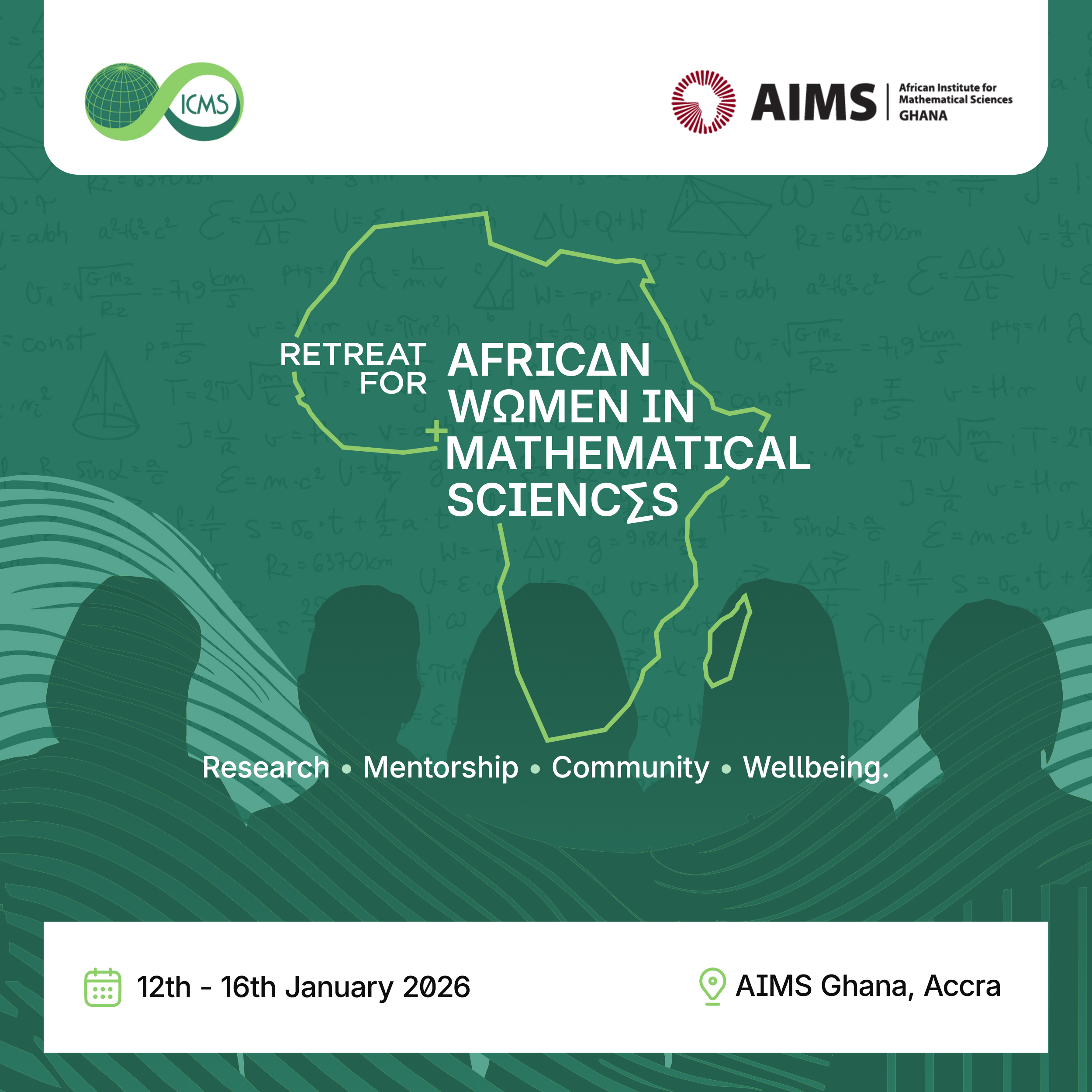
About RAWAMS 2026
This strategic workshop, to be held in Accra, Ghana, from 12th to 16th January 2026, is designed to foster a sustainable network for women in pure and applied mathematics and statistics, including those based in the diaspora. Its primary objectives are to provide structured support and mentorship for early-career researchers and to establish a unified platform for disseminating information on scientific opportunities, research funding, university-level teaching, career advancement, and other dimensions of academic practice that contribute to professional development and job satisfaction.
The program encompasses formal research presentations and structured roundtable discussions, thereby offering participants opportunities for scientific networking, community formation, the establishment of research collaborations, and the acquisition of knowledge through the exchange of experiential insights. Furthermore, the discussions will explicitly address dimensions of mental health support relevant to early-career researchers.
The primary goal is to build a strong, Africa-wide support network for women working in pure and applied mathematics and statistics. Through this network, we seek to encourage the development of new scientific ideas, promote research collaborations led by women, and offer mentoring opportunities. Our hope is that this platform will leave a lasting and meaningful impact across Africa.
The Retreat for African Women in Mathematical Sciences was established on the inspiration of the highly successful UK Retreat for Women in Applied Mathematics, which has been run four times and has played a pivotal role in fostering community, mentorship, and collaboration among women in the field. Read more.
RAWAMS 2026 Organizers
- Folashade B. Agusto – University of Kansas, USA
- Angela Tabiri – African Institute for Mathematical Sciences (AIMS) Ghana
- Karin Theresa Howell – African Institute for Mathematical Sciences (AIMS) South Africa
- Sophie Dabo-Niang – Université de Lille, France
RAWAMS 2026 Scientific Committee
- Folashade B. Agusto – University of Kansas
- Marie Françoise Ouedraogo – Université Joseph Ki Zerbo, Burkina Faso
- Marie-Françoise Roy – University of Rennes 2, France
- Olubunmi Fadipe-Joseph – University of Ilorin, Nigeria
- Bernadette Faye – Université Alioune DIOP de Bambey, Senegal
- Inger Fabris-Rotelli – University of Pretoria, South Africa
- Selma Negzaoui Negzaoui – University of Monastir, Tunisia
- Amina Eladdadi – NSF United States of America
- Aissa Wade – Pennsylvania State University, USA
- Ousmane Seydi – Ecole Polytechnique de Thiès, Sénégal
- Farai Nyabadza – University of Johannesburg, South Africa
- Eric Numfor – Augusta University, United States of America
- Moustapha Fall – President of AIMS Senegal
RAWAMS 2026 Participants
- Marie Françoise Ouedraogo, University of Ouagadougou, Burkina Faso
- Olubunmi Fadipe-Joseph, University of Ilorin, Nigeria
- Selma Negzaoui, University of Monastir Monastir, Tunisia
- Chinwendu Emilian Madubueze, Federal University of Agriculture, Makurdi, Nigeria
- Victoria Adah (grad student), Federal University of Agriculture, Makurdi, Nigeria
- Tefa Kaisara, Botswana International University of Science and Technology, Botswana
- Manalebish Debalike Asfaw, Addis Ababa University, Ethiopia
- Temitayo Olabisi Oluyo, Ladoke Akintola University of Technology, Nigeria
- Deborah Makinde, Obafemi Awolowo University, Nigeria
- Nkemdirim Ogbonna,
- Janet Koladejo, Ladoke Akintola University of Technology, Nigeria
- Sarah Nakato, Kabale University, Uganda
- Winnie Nakyiyingi, African Institute for Mathematical Sciences (AIMS) Research and Innovation Centre, Rwanda
- Gloria Botchway, University of Ghana, Legon
- Perpetual Andam Boiquaye University of Ghana, Legon
- Agnes Adom-Konadu, University of Cape Coast
- Hanifa Napari, Tamale Technical University
- Dorcas Atubea, University of Education, Winneba
- Fameno Rakotoniaina, African Institute for Mathematical Sciences (AIMS) Ghana
- Monica Crankson, University of Mine and Technology, Tarkwa
- Vida Afosaa, Sunyani Technical University
- Matilda Sarpong Adusei, University of Education, Winneba
- Edwiga K. Renald, Nelson Mandela African Institution of Science and Technology, Tanzania
- Sandra Addai-Henne, Kwame Nkrumah University of Science and Technology
- Angela Tabiri, African Institte for Mathematical Sciences Ghana
- Folashade B. Agusto, University of Kansas, USA
- Sophie Dabo-Niang, Université de Lille, France
- Anne-Françoise Yao, University of Clermont Auvergne
- Fadekemi Osaye, Troy University, USA
- Bouchra Nasri, Université de Montréal, Canada
- Aissa Wade, Penn State University
RAWAMS 2026 Program Activities
Monday – January 12, 2026
7:00 – 8:00 Breakfast at the hotel/AIMS
8:00 – 8:45 Shuttle to AIMS from hotel
8:45 – 9:00 Registration
Chair: Sophie Dabo
9:00 – 9:20 Opening – AIMS Ghana Center President: Prince Osei
Director ICMS: Minhyong Kim
9:20 – 10:20 Plenary Talk – Aissa Wade: Riemannian geometry of Jacobi manifolds.
10:20 – 10:50 Research Talk – Olubunmi Fadipe-Joseph: Curve AI: The Role of Sigmoid Function in Geometric Function Theory
10:50 – 11:20 Research Talk – Fadekemi Osaye: Distance Measures in k-Connected Tournaments
Tea/coffee break from 11:20-11:30 am
Chair: Folashade Agusto
11:30 – 12:30 Plenary Talk – Chinwendu Emilian Madubueze: Mathematical analysis, optimal control, and economic evaluation of Lassa fever transmission
12:30 – 1:00 Research Talk – Victoria Adah: A Bayesian Poisson-Gamma Modeling of Lassa Fever Incidence
1:00 – 1:30 Research Talk – Tefa Kaisara: Modelling HIV/AIDS response and treatment policy changes: Insights from a cascade of mathematical models
Lunch from 1:45-2:30pm
Chair: Selma Negzaoui
3:00 – 3:30 Research Talk – Edwiga Renald: Parameter Identifiability, Uncertainty, and Sensitivity Analyses of a Lumpy Skin Disease Model
3:30 – 4:00 Research Talk – Deborah Makinde: Operator-Modified SIR Model for Epidemic Forecasting: A Case Study of COVID-19 in Nigeria
4:00 – 4:30 Research Talk – Sarah Nakato: Factorization behaviour in rings of integer-valued polynomials
4:30 – 5:00 Research Talk – Angela Tabiri: Decomposable surfaces and plane curves which are quantum homogeneous spaces
5:00 – 6:30 Networking
Dinner from 6:30-7:30pm
8:00 Shuttle back to hotel from AIMS
Tuesday – January 13, 2026
7:00 – 8:00 Breakfast at the hotel/AIMS
8:00 – 8:45 Shuttle to AIMS from hotel
8:45 – 9:00 Registration
Chair: Anne-Françoise Yao
9:00 – 10:00 Plenary Talk – Sophie Dabo: Heteroskedastic Choice-Based Sampling Spatial Choice Models: Application to cancer modeling
10:00 – 10:30 Research Talk – Hanifa Napari: What Do the Data Really Say? Applied Statistical Insights from a Deployed Health AI
10:30- 11:00 Research Talk – Bouchra Nasri: Dependence Modelling
Tea/coffee break from 11:00-11:30 am
Chair: Aissa Wade
11:30 – 12:30 Plenary Talk – Selma Negzaoui: Lipschitz Spaces and Bochner-Riesz Means for a Generalized Fourier Transform
12:30 – 1:00 Research Talk – Marie Françoise Ouedraogo: From Pseudo-Differentials to Fourier Integral: Boundedness of Operators on Lp(.)(T^n) Spaces
1:00 – 1:30 Research Talk – Nkemdirim Ogbonna: Image method solution for a screw dislocation in a multicoated cylindrical composite
Lunch from 1:45-2:30pm
Chair: Olubunmi Fadipe-Joseph
3:00 – 3:30 Research Talk – Vida Afosaa: Haar Wavelet Scheme to solve Systems of Linear Fractional Order Differential Equations in Jumarie
3:30 – 4:00 – Research Talk – Agnes Adom-Konadu: Navigating Academia: A Strategic Framework for Women in Mathematics
4:00 – 5:30 Mentor-mentee event
- Tinuke Adebanji (Virtual): Female Scientist: The Quiet Cost of Excellence
- Olubunmi Fadipe-Joseph: Mathematics as a Language of Possibility: Empowering Girls and Shaping Africa’s Future
5:30 – 6:30 Networking
Dinner from 6:30-7:00pm
8:00 Shuttle back to hotel from AIMS
Wednesday – January 14, 2026
7:00 – 8:00 Breakfast at the hotel/AIMS
8:00 – 8:45 Shuttle to AIMS from hotel
8:45 – 9:00 Registration
Chair: Chinwendu Emilian Madubueze
9:00 – 10:00 Plenary Talk (Virtual) – Farai Nyabadza: On the Concept of Digital Pathogens and the Psychosocial Epidemiology of Future Techno-Pandemics
10:00 – 10:30 Research Talk – Monica Crankson: Optimal Control and Cost-Effectiveness Analysis of a Two-Strain Bacterial Meningitis Epidemic Model: Insights for Effective Public Health Interventions
10:30- 11:00 Research Talk – Temitayo Olabisi Oluyo: Mathematical Analysis and Cost-Effective Optimal Control of Smoking Dynamics with Dual Relapse Pathways
11:00 – 11:30 Research Talk – Janet Koladejo: Analysis of HIV/AIDS Model with risk compensation effects among Pre-Exposure Prophylaxis users and infectious immigrants
Tea/coffee break from 11:30-11:45 am
Chair: Marie-Françoise Ouedraogo
11:45 – 12:45 Plenary Talk (Virtual) – Fati Kirakoya: When Bigger Is Riskier: Epidemiological and Statistical Insights into Fetal Overgrowth and Neonatal Mortality in Low- and Middle-Income Countries
12:45 – 1:15 Research Talk – Perpetual Andam Boiquaye: Optimizing Interest Rates and Penalties in Microfinance Repayment Systems
1:15 – 1:45 Research Talk (Virtual) – Phyllis Muniu: Exploring Spatio-Temporal Trends and Clusters of Mental Health During COVID-19 in the Great Plains and Rocky Mountain Regions
Lunch from 1:45-2:30pm
2:30-3:00 Research Talk (Virtual) – Mahlet Tadesse: Bayesian graph-structured variable selection
3:00 – 6:00 Social event – Accra City Tour
Dinner from 6:00-7:00pm
8:00 Shuttle back to hotel from AIMS
Thursday – January 15, 2026
7:00 – 8:00 Breakfast at the hotel/AIMS
8:00 – 8:45 Shuttle to AIMS from hotel
8:45 – 9:00 Registration
Chair: Fadekemi Osaye
9:00 – 10:00 Plenary Talk – Folashade Agusto: From cultural practices to risky behaviors to public sentiment: Modeling human behavior and disease transmission
10:00 – 10:30 Research Talk – Martina Mthombeni: Understanding the Population Growth of an Invasive Asian Longhorned Tick Species
10:30- 11:00 Research Talk – Fameno Rakotoniaina: Biophysical modeling of invasion of red blood cell by Plasmodium falciparum
Tea/coffee break from 11:00-11:30 am
Chair: Nkemdirim Ogbonna
11:30 – 12:30 Plenary Talk – Research Talk (Virtual) – Nsoki Mavinga: Solvability of nonlinear boundary value problems via sub- and supersolution method
12:30 – 1:00 Research Talk – Dorcas Atubea: Hybrid Quantum-Classical Study of Ground-State Energies in Fe Nanoclusters using VQE and DFT
1:00 – 1:30 Research Talk (Virtual) – Blessing Emerenini: Mathematical modeling of quorum-sensing-controlled corrosion inhibition
Lunch from 1:45-2:30pm
Chair: Angela Tabiri
3:00 – 3:30 Research Talk – Anne-Françoise Yao: On non-parametric density estimation on Riemanian Manifold
3:30 – 4:00 Research Talk – Sandra Addai-Henne: Stress-testing and Early-Warning Indicators for Pension Sustainability under Data Scarcity: Evidence from Ghana’s Public Pension Scheme
4:00 – 5:00 Career talks
Bouchra Nasri: Being a woman in mathematics: an exciting and inspiring journey, full of gratitude and growth.
Round table panelist
- Bouchra Nasri
- Marie Françoise Ouedraogo
- Anne-Françoise Yao
- Sana Louhichi
- Mahlet Tadesse
- Selma Negzaoui
- Karin Theresa Howell
Chair/ Coordinator : Bouchra Nasri
5:00 – 6:30 Networking
Banquet from 6:30-9:00pm
9:00 Shuttle back to hotel from AIMS
Friday – January 16, 2026
7:00 – 8:00 Breakfast at the hotel/AIMS
8:00 – 8:45 Shuttle to AIMS from hotel
Chair: Angela Tabiri
9:00 – 10:00 Mental health talk – Gladys Setordzie: Thriving Together, Mental Well-Being for All
10:00 – 10:30 Research Talk – Winnie Nakiyingi: How Community, Narrative, and Support Shape African Women’s Journeys in Mathematical Sciences
Chair: Folashade Agusto, Sophie Dabo
11:00 – 12:00 Take home messages, lessons learnt and next step.
Round table panelist
- Folashade Agusto,
- Sophie Dabo
- Angela Tabiri
12:00 – 1:00 Closing
Lunch from 1:45-2:30pm
Dinner from 5:00-6:00pm
Click HERE to download

RAWAMS Abstracts 2026
Monday – January 12, 2026
Plenary Talk: Riemannian geometry of Jacobi manifolds
Aissa Wade
Pennsylvania State University, USA
Symplectic geometry on smooth even-dimensional manifolds is a branch of differential geometry that has very strong connections with topology, analysis, algebraic geometry, physics, and engineering. Similarly, its odd-dimensional analog, which is called contact geometry, has a wide range of applications across mathematics and theoretical physics. Jacobi geometry is a unifying generalization of both symplectic and contact geometry, and it appears naturally in mechanics and thermodynamics. In this talk, we will first review local and global aspects of Jacobi manifolds. Then we will introduce a new concept of Riemann-Jacobi structure bridging Kähler and Sasakian structures. Various examples of Riemann –Jacobi structures will be discussed.
Curve AI: The Role of Sigmoid Function in Geometric Function Theory
Olubunmi Fadipe-Joseph
University of Ilorin, Nigeria
Geometric Function Theory(GFT) is a branch of complex analysis which studies geometric properties of analytic functions. One of the major interests in GFT is finding the coefficient bounds of univalent and multivalent functions. The bounds determine the growth, distortion properties among others of the analytic functions. Special functions are of great interest in mathematics, mathematical physics, engineering and other fields of science. They are rich in terms of practical applications in solving a wide range of problems. In this work, special functions in geometric function theory were investigated. In particular, the connections between sigmoid function and geometric function theory were established. The work was concluded by giving possible intersection of Geometric Function Theory and artificial intelligence (AI), specifically focusing on the application of sigmoid functions as a critical analytical tool.
Distance Measures in k-Connected Tournaments.
Fadekemi Osaye
Troy University, USA
Let G be a directed graph (digraph) with a set of vertex V(G) and an arc set E(G). A tournament is a directed graph obtained by assigning a direction from each edge in an undirected complete graph. A vertex u is said to be reachable from v in G if there is a directed path from u to v, and the number of arcs in a shortest such path is the distance, denoted d(v,u). The distance from v to a vertex furthest from v is the eccentricity of v, and the mean of all eccentricities is the average eccentricity of G, avec(G). In a previous paper by Dankemann and Volkmann, it was shown that the mean distance for a tournament connected to k is less than n/6k + O(1). In this paper, we show that if G is a k-connected tournament of order $n$, then the average eccentricity as an alternate distance measure is given as $avec(G) < 3n/k + O(1). We further show that this bound is best possible apart from the additive constant.
Plenary Talk: Mathematical analysis, optimal control, and economic evaluation of Lassa fever transmission
Chinwendu Emilian Madubueze
Federal University of Agriculture, Makurdi, Nigeria
Lassa fever is a hemorrhagic infection primarily caused by Mastomys rats. Despite various interventions, it remains a recurring challenge, especially in West Africa. This study investigates the combined roles of environmental contamination, rodent dynamics, and intervention strategies in the transmission of Lassa fever using a comprehensive mathematical modelling framework. A novel SEQIR–SEI–C model is developed to describe interactions among human and rodent populations and environmental contamination, which serves as a key transmission pathway. Analytical and numerical results show that quarantine rates, rodent population growth, and contamination clearance significantly influence disease dynamics. Incorporating seasonal variability through a non-autonomous model with periodic rodent growth, the disease-free periodic equilibrium is shown to be locally asymptotically stable when the time-dependent reproduction number is less than unity. Sensitivity analysis using Latin Hypercube Sampling identifies the most influential parameters driving transmission. An optimal control problem involving five intervention strategies—vector control, personal protection, quarantine, public health education, environmental disinfection, and proper food handling—is analyzed using Pontryagin’s Maximum Principle. Cost-effectiveness analysis reveals that while combined interventions yield the greatest reduction in infections, vector control coupled with quarantine is the most economically efficient strategy under limited resources. These findings offer valuable insights for designing cost-effective policies to reduce Lassa fever transmission. Keywords: Lassa Fever; Equilibrium point; Bifurcation Analysis, Sensitivity Analysis, Periodic, Optimal control; Cost-Effectiveness Analysis
A Bayesian Poisson-Gamma Modeling of Lassa Fever Incidence
Victoria Adah
Federal University of Agriculture, Makurdi, Nigeria
West African-endemic Lassa fever is a viral hemorrhagic illness with complex transmission dynamics and frequent underreporting, resulting in noisy and scattered surveillance data. Accurate incidence estimates and outbreak prediction are hindered by the tendency of traditional Poisson models to underestimate variability in such data. In order to estimate the weekly incidence of Lassa fever, adjust for overdispersion, and provide prediction distributions for future cases, this study assesses a Bayesian Poisson-Gamma modeling framework. The Bayesian Poisson-Gamma technique was used to simulate weekly laboratory-confirmed cases of Lassa disease in Nigeria during 2024-2025. While a Gamma prior on the rate parameter permitted overdispersion, the Poisson probability was for the observed counts. To evaluate model fit, posterior predictive tests were carried out after posterior distributions were derived analytically. The posterior parameter was used to forecast future weekly incidence for 2026. The mean weekly incidence decreased by 24-25% between 2024 and 2025, peaking in early 2024 at 109 cases per week and early 2025 at 54 cases per week. Credible variations in underlying rates were shown by the well-separated posterior distributions for the two years. Although the model somewhat underestimated extreme weekly counts, posterior predictive testing verified that it reflected core trends and overdispersion. Model-based forecasts for 2026 supported readiness planning by providing reasonable ranges for weekly cases. The Bayesian Poisson-Gamma model effectively accommodates overdispersed Lassa fever count data, providing more accurate incidence estimates and predictive distributions than standard Poisson models. This approach can enhance surveillance efforts, optimize resource allocation, and improve outbreak response strategies in regions where the disease is endemic.
Modelling HIV/AIDS response and treatment policy changes: Insights from a cascade of mathematical models
Tefa Kaisara
Botswana International University of Science and Technology, Botswana
Modelling HIV/AIDS response and treatment policy changes: Insights from a cascade of mathematical models Tefa Kaisara Botswana International University of Science and Technology (BIUST) Abstract The management of HIV/AIDS has evolved ever since the advent of the disease in the past four decades. Many countries have had to revise their policies as new information on the virus and its transmission dynamics emerged. In this study, we track the changes in Botswana’s HIV/AIDS response and treatment policies using a piece-wise system of differential equations. The treatment policy shifts are tracked in three epochs. Models for each era are formulated from a “grand model” that can be linked to all the epochs. The resulting models are calibrated using HIV/AIDS prevalence data from Botswana spanning the last three decades. The changes in the populations in each compartment are tracked as the response to the disease and treatment policy changes over time. Finally, projections are made to determine the possible trajectory of HIV/AIDS in Botswana. The effects of successive policy changes are clearly evident in the model outcomes, enabling a focused discussion of their impact on the progression and control of the epidemic.
Parameter Identifiability, Uncertainty, and Sensitivity Analyses of a Lumpy Skin Disease Model
Edwiga Renald
Nelson Mandela African Institution of Science and Technology, Tanzania
Lumpy Skin Disease (LSD) is a contagious deadly disease of cattle caused by Lumpy Skin Disease Virus (LSDV) transmitted through blood-feeding vectors such as flies, mosquitoes, and some species in ticks. Here, a deterministic Susceptible-Exposed-Infectious-Recovered-Susceptible (SEIRS) mathematical model for LSD, which takes into account the vector population and other key epidemiological parameters, such as the LSD-induced mortality rate, the biting rate, and the waning rate of infection-induced immunity for a previously recovered cattle, has been developed. The model’s validity and reliability were tested using both synthetic data to assess the overall model’s performance and real data to verify its practical relevance and applicability in specific settings. Parameters of the model were verified for data uncertainty using Adaptive Markov Chain Monte Carlo method. Results indicate that the model is reliable for use provided that parameter estimates are obtained from data with a reasonable amount of noise, and enough data time points spanning through the model classes. Local sensitivity was carried out to determine the contribution of each parameter that appears in the basic reproduction number, . Moreover, global sensitivity analysis was carried out to determine the contribution of all parameters to the model. Results indicated biting rate, to be the most positively sensitive parameter followed by parameters measuring chances of infection in each population. Here, a recovery rate of 17.2% with a biting rate of approximately 57.4% can reduce the initial disease transmission to below unity. Notably, the waning rate of LSD infection-induced immunity, has been observed to have increased its significance from the beginning of infection onward. These findings suggest that control efforts should prioritize resources toward the most sensitive parameters to effectively reduce LSD transmission in the host populations.
Operator-Modified SIR Model for Epidemic Forecasting: A Case Study of COVID-19 in Nigeria
Deborah Makinde
Obafemi Awolowo University, Nigeria
Accurate forecasting of COVID-19 dynamics is essential for timely intervention. We compare the classical SIR model of Kermack and McKendrick with an operator-modified SIR formulation based on the Makinde differential operator. Using weekly Nigerian data (AprilMay 2025) on COVID-19, we estimate classical transmission and recovery rates (βt, γt), which range from 0.01710–0.03305 and 0.014770.02964 per day, respectively (Table ??). We also derive curvature-corrected operator rates (βM,t,γM,t) using second-order incidence changes, yielding smoother estimates: βM,t ≈ 10−10, γM,t ≈ 0.0230–0.0298 (Table ??). Each model is discretized to predict new cases and evaluated by root-mean-square error (RMSE), Akaike Information Criterion (AIC), and peak-magnitude comparison. The classical SIR exactly reproduces in-sample data (RMSE = 0, undefined AIC, peak = 6560), whereas the modified model yields RMSE ≈ 652.3, AIC ≈ 124.5, and a smoother predicted peak (≈ 2009.8 cases), indicating improved generalizability. These results affirm the utility of memory-augmented epidemic models in forecasting and intervention-sensitive policy design under data uncertainty.
Factorization behaviour in rings of integer-valued polynomials
Sarah Nakato
Kabale University, Uganda
Let D be an integral domain with quotient field K. The ring of integer valued polynomials on D is defined by
Int(D) = {f ∈ K[x] | f(D) ⊆ D}.
This ring exhibits rich factorization behaviour that gives information about its algebraic properties. In this talk, I will give an overview of my research on non-unique factorizations in Int(D) and highlight some of the open problems in the area. I will also present key algebraic properties and generalizations of Int(D).
Decomposable surfaces and plane curves which are quantum homogeneous spaces
Angela Tabiri
African Institute for Mathematical Sciences (AIMS), Ghana
Decomposable plane curves of degree up to 5 were shown to be quantum homogeneous spaces by Brown and Tabiri. It was conjectured that all decomposable plane curves of any degree are quantum homogeneous spaces. In this talk, we will discuss recent results which show that decomposable surfaces and plane curves of any degree are quantum homogeneous spaces. Other algebras such as the reduced algebra will be constructed and its properties discussed.
Tuesday – January 13, 2026
Plenary Talk: Heteroskedastic Choice-Based Sampling Spatial Choice Models: Application to cancer modeling.
Sophie Dabo
Université de Lille, France
Spatial binary models are useful in many areas such as in economics and epidemiology where activities are often located in space. A way that makes the analysis of such spatial activities possible is to find a kind of correlation between some random variables in one location with others at neighboring locations. We proposed here to describe and analyze the spatial (geographical) variation in disease (cancer) with respect to some risk factors using spatial binary models containing spatial latent choice variable and/or spatial autoregressive disturbances in a context of sampling data. This permits to account both spatial and non-random sampling of the sample of interest. After giving the model and the estimation procedure, we perform some numerical Monte-Carlo results before applying the model to identify cancer risk factors.
What Do the Data Really Say? Applied Statistical Insights from a Deployed Health AI
Hanifa Napari
Tamale Technical University & Mary Global Health, Ghana
Digital health systems are increasingly deployed across Africa, yet real-world usage is often evaluated using averages that obscure significant skewness and heterogeneity in user behavior. This study presents an applied statistical characterization of interaction logs from AskMary, a conversational health AI system deployed by Mary Global Health (MGH). Using a 22-day window of de-identified message-level logs, we applied robust descriptive statistics and exploratory methods to analyze temporal patterns, engagement levels, and thematic content. We utilized Latent Dirichlet Allocation (LDA) (k=6) for topic modeling and the Flesch Reading Ease (FRE) score to evaluate the accessibility of user-generated text. Because session lengths were found to be heavily right-skewed, the analysis prioritizes medians and Interquartile Ranges (IQRs) over means to ensure reporting integrity. The analysis revealed that AskMary functions primarily as a dialogic tool rather than a simple lookup utility, with 85.9% of sessions being multi-turn and 38.6% of sessions exceeding 11 messages. Temporal analysis showed clear diurnal and episodic usage patterns. LDA modeling identified three dominant themes: General Health Information-Seeking (40.4%), Symptom Description (27.6%), and Health Services/Clinical Access (19.2%). Readability analysis yielded a median FRE of 82.39, indicating that the system is accessible to users with a primary to junior-high reading level. Careful descriptive statistics reveal a complex, time-structured, and highly heterogeneous engagement with health AI. By applying robust mathematical frameworks, researchers can accurately characterize user behavior in deployed systems without over-claiming clinical effectiveness, providing a more transparent foundation for the evaluation of digital health interventions in Africa.
Dependence Modelling
Bouchra Nasri
Université de Montréal, Canada
Dependence modelling is a statistical tool that aims to understand the “link” between two or more variables of interest (or observations). In this presentation, I will discuss the use of different dependence models in contexts such as regression, time series, and spatial models. Examples from epidemiological surveillance, including infectious disease surveillance, will illustrate the methodologies discussed.
Plenary Talk: Lipschitz Spaces and Bochner-Riesz Means for a Generalized Fourier Transform
Selma Negzaoui
University of Monastir, Tunisia
We present a unified framework for Lipschitz spaces associated with the (kn)-generalized Fourier transform, which includes the classical Fourier, Dunkl, and DunklHankel transforms as particular cases. For 0 < 1 n , we introduce the generalized Lipschitz spaces k n and investigate their main properties. We establish the almost everywhere convergence of the corresponding BochnerRiesz means and show that these means provide a characterization of the generalized Lipschitz spaces. In addition, we discuss approximation results for functions in L2(d k n) obtained through partial Fourier integrals. The analysis relies on tools from harmonic analysis, convolution operators with approximate identities, and the HardyLittlewood theorem.
From Pseudo-Differentials to Fourier Integral: Boundedness of Operators on Lp(.)(T^n) Spaces
Marie Françoise Ouedraogo
Université Joseph KI-ZERBO, Burkina Faso
Pseudo-differential operators play a fundamental role in harmonic analysis and the theory PDE. They can often be represented or approximated by Fourier integral operators, allowing their functional properties to be studied using Fourier transform tools. This presentation explores the link between pseudo-differential operators and Fourier integral operators on the torus, focusing on the boundedness of the latter in the context of variable exponent spaces. The study illustrates how the spectral structure of the torus and variations in the exponent influence the regularity and bound of the operators, offering perspectives for applications in harmonic analysis and in PDE theory on spaces with periodic geometry.
Image method solution for a screw dislocation in a multicoated cylindrical composite
Nkemdirim Ogbonna
Michael Okpara University of Agriculture, Nigeria.
The image method of solving certain boundary value problems in electrostatics is presented and adapted to solve the elasticity problem of interaction of a screw dislocation with a multicoated cylindrical inhomogeneity. The force of interaction is derived in closed form and validated by exhibiting its agreement with existing solutions for special cases. Possible equilibrium positions for the dislocation are obtained, leading to a deduction that the number of equilibrium positions is equal to the number of coatings in the cylindrical inhomogeneity. This presentation illustrates the power of using the concept of mirror images to facilitate the solution of appropriate complex boundary value problems in elasticity.
Haar Wavelet Scheme to solve Systems of Linear Fractional Order Differential Equations in Jumarie
Vida Afosaa
Sunyani Technical University, Ghana
In this research, we developed a methodology using the Haar wavelet collocation method to solve systems of linear fractional order differential equations (FODEs). The fractional derivative is understood in the context of Jumarie. The proposed technique consists of an operational matrix method along with collocation points which converts the system of FODEs to algebraic equations. It was found that using Haar wavelets to estimate linear FODEs is easy, direct, and effective. The obtained findings show that this method is a useful and practical mathematical tool for solving linear FODE systems.
Navigating Academia: A Strategic Framework for Women in Mathematics
Agnes Adom-Konadu
University of Cape Coast, Ghana
Despite the evolving landscape of higher education, women in mathematics continue to face unique systemic challenges, ranging from implicit bias to a lack of visible mentorship. This presentation synthesizes personal narrative with qualitative insights to examine the specific barriers women face within math-based academia. By analyzing the intersection of gender-based stereotypes and institutional structures, the session provides a strategic framework for career advancement. Key areas of focus include the cultivation of diverse professional networks, the role of proactive mentorship, and the implementation of sustainable work-life integration. Ultimately, this talk offers actionable strategies designed to empower women mathematicians and provide insights to help foster a more inclusive academic environment.
Female Scientist: The Quiet Cost of Excellence
Tinuke Adebanji
Purdue University, USA
Female scientists continue to make substantial how be it not often celebrated contributions to innovation, leadership, and sustainable development especially in Africa – we contribute quietly. In this talk, I present a reflection on what it truly means to be a female scientist in our context where brilliance alone is not enough. I will draw from my lived professional experience and that of other female scientists, to explore the difference between participation and inclusion, and why the latter remains elusive for many women in STEM.
As women, we bring our unique strengths to science and technology, as caregivers, innovators, and leaders, but these strengths often come with hidden costs. The most common being age restrictions on fellowships that intersect with our biological realities; visibility requiring absenteeism from family; gaps in CVs are penalized; and cultural stereotypes As women, we bring our unique strengths to science and technology, as caregivers, innovators, and leaders, but these strengths often come with hidden costs. Age restrictions on fellowships intersecting with our biological realities; visibility requiring absenteeism from family; career pauses are penalized; and cultural stereotypes that continue to shape available and accessible opportunities. Although some progress has been made, and women are more visible in research, but representation alone does not guarantee equity or sustainability. For women, the journey to actualization and relevance is rarely linear nor painless.
In this talk, I will attempt to argue that the real question is not whether women belong in STEM, but whether our systems are designed to let us thrive. Paying the price for excellence should not mean self-erasure. By embracing authenticity, building strong networks, aligning policy with gender-sensitive funding, and remaining culturally rooted yet globally competitive, women scientists can transform both science and society.
Mathematics as a Language of Possibility: Empowering Girls and Shaping Africa’s Future
Olubunmi Fadipe-Joseph:
University of Ilorin, Nigeria
Mathematics is often perceived as a collection of abstract numbers and symbols, yet it functions more profoundly as a language of possibility and a driver of innovation. It is a transformative tool that unlocks opportunities, guides technological advancement, and enables solutions that address pressing human challenges. Central to this narrative is the importance of representation and inclusion within the mathematical sciences, particularly for young girls across Africa. Mathematics, when positioned as both a technical discipline and a human-centered practice, becomes a compass for equitable development and social impact. Empowering young girls to engage confidently with mathematics not only nurtures individual potential but also strengthens the collective capacity for innovation, leadership, and sustainable progress across the continent and beyond.
Wednesday – January 14, 2026
Plenary Talk: On the Concept of Digital Pathogens and the Psychosocial Epidemiology of Future Techno-Pandemics
Farai Nyabadza
University of Johannesburg, South Africa
Institute of Applied Research and Technology, Emirates Aviation University, UAE
The accelerating evolution of digital technologies has given rise to a new class of cognitive and affective disturbances herein conceptualized as Digital Pathogens (DPs). Unlike biological agents, DPs propagate through algorithmic exposure, neurocognitive entrainment, and behavioural reinforcement within hyperconnected digital ecosystems. This study identifies six high-risk entities—Anxietovirus sapiens, Narcissomia proliferata, Echochamberis compulsiva, Contentitis viralis, Statitis contagiosa, and FOMOvirus persistens that are metaphorical constructs modelled after epidemiological and psychological analogues, each representing a distinct psychosocial infection pattern arising in hyper-digitalized societies. We give examples drawn from network models. The results indicate that these psychosocial contagions possess epidemic potential analogous to biological pathogens, with self-sustaining transmission dynamics mediated by digital feedback loops and algorithmic amplification. Without immediate and coordinated interventions in digital public health, humanity risks entering a phase of persistent psychosocial endemicity, characterized by chronic emotional dysregulation and cognitive overload at the population scale.
Keywords: Digital pathogens, Techno-pandemics, algorithmic exposure, hyper-digitalized, network models
References
[1] Martinez-Vaquero, L.A., Dolci, V. and Trianni, V. Evolutionary dynamics of organised crime and terrorist networks. Sci Rep 9, 9727 (2019). https://doi.org/10.1038/s41598-019-46141-8
[2] Lacey, A. A. and Tsardakas M. N.. A mathematical model of serious and minor criminal activity. European J. Appl. Math., 27(3):403–421, 2016.
[3] Gebrezabher, Z. H., and Eroglu, D. (2024). Mathematical modeling of the role of imitation in crime dynamics. *arXiv preprint*, arXiv:2410.09989.
Optimal Control and Cost-Effectiveness Analysis of a Two-Strain Bacterial Meningitis Epidemic Model: Insights for Effective Public Health Interventions
Monica Crankson
University of Mines and Technology (UMaT) Tarkwa, Ghana
Bacterial meningitis remains a critical public health concern, particularly in sub-Saharan Africa and countries within the meningitis belt, where recurrent outbreaks result in significant morbidity and long-term disabilities among survivors. Despite advancements in treatment, the disease continues to pose a major threat due to its rapid transmission and debilitating effects. This study presents an optimal control model for the transmission dynamics of bacterial meningitis, focusing on a two-strain scenario that more accurately reflects real-world conditions. The model incorporates strategies such as effective human personal protection, vaccination for both strains and treatment for timely and delayed diagnosis to assess their impact on disease control, with an emphasis on minimizing long-term consequences for the recovered population. Using Pontryagin’s Maximum Principle (PMP), we establish the existence of its solution and characterize the controls. The Forward-Backward Sweep (FBS) method is employed to solve the optimal control problem, including the adjoint equations, for better numerical solutions. Real-life data from the Ghana Center for Disease Control is utilized to parameterize the model, ensuring its relevance to endemic regions. The results reveal that the most efficient and cost-effective strategy involves the combined use of all five control variables. In particular, a strategy involving the human personal protection (such as face masks) also emerges as a highly effective approach. Based on these findings, we provide actionable recommendations for policymakers in endemic areas, emphasizing cost-efficient interventions that can significantly reduce the burden of bacterial meningitis.
Mathematical Analysis and Cost-Effective Optimal Control of Smoking Dynamics with Dual Relapse Pathways
Temitayo Olabisi Oluyo
Ladoke Akintola University of Technology, Ogbomoso, Nigeria.
This study develops a nonlinear compartmental model for smoking dynamics that classifies individuals into potential smokers, active smokers, and quitters, while explicitly incorporating relapse into both the smoking and potential-smoking classes. The model captures initiation, cessation, and relapse mechanisms that shape long-term smoking behavior in a population. An optimal control problem is formulated within a quadratic cost framework to evaluate the effectiveness of three intervention strategies: awareness campaigns, employer-based incentives, and medical-aid support for cessation. The corresponding optimality system is derived using Pontryagin’s Maximum Principle. Numerical simulations illustrate how timely, single, and combined implementations of the control strategies substantially reduce smoking prevalence and limit relapse-driven resurgence. The findings underscore the importance of coordinated, sustained interventions and offer evidence-based guidance for designing cost-effective public health policies aimed at reducing the population-level burden of smoking.
Analysis of HIV/AIDS Model with risk compensation effects among Pre-Exposure Prophylaxis users and infectious immigrants
Janet Koladejo
Ladoke Akintola University of Technology, Nigeria.
Pre-Exposure Prophylaxis (PrEP) is a promising HIV prevention strategy, and its provision has grown rapidly in several countries, including those in Sub-Saharan Africa. However, lingering concerns remain that introducing PrEP may lead to unintended consequences, such as decreased adherence to other prevention methods and increased risky sexual behaviour, culminating in risk compensation. This study employs a six-compartment mathematical model to investigate the effects of risk compensation behaviour among PrEP users in a population with an influx of infectious immigrants. The model exhibits only disease-free equilibrium points in the absence of infective immigrants and endemic equilibrium with the influx of infected immigrants. The disease-free equilibrium point exists and is locally and globally asymptotically stable in the absence of infective immigrants when the basic reproduction number is less than one. In contrast, the model exhibits only endemic equilibrium in the presence of infective immigrants, which is asymptotically stable when basic reproduction number exceeds unity. A sensitivity analysis of the parameters associated with $R_1$ was performed using the normalized forward sensitivity index to determine the most influential parameter. The analysis revealed that the number of sexual partners had the greatest influence on disease endemicity. Numerical simulations supported the analytical findings, showing that risk compensation undermines PrEP effectiveness and that multiple sexual partners increase new HIV infections. However, PrEP can significantly reduce new infections in a population with varying immigrant influx and no risk compensation behaviour, highlighting its potential impact in controlling HIV spread. The effectiveness of PrEP depends on strict adherence to usage in combination with other preventive measures. The disease persists with the inflow of infective immigrants.
Keyword: Bifurcation, Infectious immigrants, Pre-Exposure Prophylaxis (PrEP), Prevention, Risk compensation.
Plenary Talk: When Bigger Is Riskier: Epidemiological and Statistical Insights into Fetal Overgrowth and Neonatal Mortality in Low- and Middle-Income Countries
Fati Kirakoya
Université Libre de Bruxelles, Belgium
Neonatal mortality research in low- and middle-income countries (LMICs) has traditionally focused on small and preterm newborns, with limited attention to fetal overgrowth. Drawing on my research within the Vulnerable Newborn Measurement Collaboration, this talk examines the prevalence of large-for-gestational-age (LGA) and macrosomic births and their association with neonatal mortality across multi-country LMIC cohorts. In heterogeneous datasets, median-based summaries with interquartile ranges, rather than pooled averages, provide more robust and interpretable measures of prevalence and mortality, capturing meaningful variation across settings. The talk also addresses statistical challenges related to rare and zero-event data and presents methodological solutions using random-effects meta- analysis and log-binomial models for adjusted risk estimation. These approaches reveal overlooked mortality risks at the upper tail of birthweight distribution and demonstrate how careful statistical choices can strengthen inference in global health research.
Optimizing Interest Rates and Penalties in Microfinance Repayment Systems
Perpetual Andam Boiquaye
University of Ghana, Legon, Ghana
Microfinance institutions (MFIs) provide financial services for underserved people. Its sustainability depends mostly on curbing risks and managing the behavior of a borrower effectively. In this paper, we employ a Markov chain model to describe individual default dynamics in Ghanaian microfinance institutions. The model was developed using data from a Ghanaian microfinance institution and did not include any macroeconomic variables. In the context of individual lending, this study looks into scenarios in which certain applicants/borrowers may strategically delay repayments, as is common in many developing countries. We show that strategic delay can be effectively mitigated by applying a fair interest rate and appropriate penalty, and we do so by developing formulas for the interest rate and penalty structures to ensure that borrowers who pay on time have an advantage over those who delay in repayment. Our findings show that beneficiaries (borrowers who repay their loan on time) see a significant rise in wealth as the number of individuals in the beneficiary state increases, whereas those in the delay state have slower growth with varied interest rates. In addition to that, there is an increase in their marginal wealth. Moreover, the interest rate can be higher than 100% when there are few beneficiaries. Finally, as the interest rate declines, so does the penalty, but the penalty-to-interest rate ratio increases, which shows a trade-off in contract design. The result shows that having a fair interest rate and penalties improves early repayment and helps them accumulate more wealth for the sustainability of their business and homes.
Exploring Spatio-Temporal Trends and Clusters of Mental Health During COVID-19 in the Great Plains and Rocky Mountain Regions
Phyllis Muniu
University of Kansas, USA
Mental health is a critical determinant of well-being, yet access to care remains uneven across the United States, particularly in the Great Plains and Rocky Mountains where high costs and limited treatment infrastructure exacerbate disparities. Understanding the spatial and temporal distribution of mental health outcomes in these regions is essential for targeted public health interventions. This study examines the spatiotemporal dynamics of frequent mental distress (FMD) across counties in the Great Plains and Rocky Mountains from 2019 to 2023, encompassing the COVID-19 period. We assess the influence of socio-demographic and economic factors using geographically and temporally weighted regression (GTWR) and multiscale geographically and temporally weighted regression (MGTWR) to capture spatial and temporal non-stationarity. Results indicate that race, gender, household income, and age are significant determinants of FMD, while the effects of unemployment, rural population, and access to care vary substantially across space and time. Spatial autocorrelation analyses identify persistent clusters of high FMD in Kansas, Nebraska, Oklahoma, and Texas, and consistently low levels in North Dakota, Wyoming, and Montana.
Bayesian graph-structured variable selection
Mahlet Tadesse
Georgetown University
A graph structure is commonly used to characterize the dependence between variables, which may be induced by time, space, biological networks or other factors. Incorporating this dependence structure into the variable selection process can increase the power to detect subtle effects without increasing the probability of false discoveries and can improve the predictive performance. In this talk, I will present methods we have proposed to accomplish this in the context of spike-and-slab priors as well as global-local shrinkage priors. For the former, we specify a binary Markov random field prior that leverages evidence from correlated outcomes on the variable selection indicators to identify outcome-specific covariates. For the latter, we combine a Gaussian Markov random field prior with a horseshoe prior to perform selection on graph-structured variables. We illustrate the methods using epigenomic, genomic and transcriptomic data.
Thursday – January 15, 2026
Plenary Talk: From cultural practices to risky behaviors to public sentiment: Modeling human behavior and disease transmission
Folashade Agusto
University of Kansas, USA
North-West University, South Africa
Human behavior refers to the way humans act and interact with each other. It is moderated by factors like cultural values, individual attitudes, politics, religion, and genetic make-up. In this seminar, I will present three different epidemic models that includes human behavior from Ebola, to Methicillin Resistant Staphylococcus aureus (MRSA), and to COVID-19. One of these behaviors is influenced by cultural practices, another by risky behaviors, and the third is moderated by public sentiment. I will show how we accounted for these behaviors from simply using a parameter to using approaches from social sciences to using Twitter data to quantify functional forms for public sentiment. I will close by exploring the role of these behaviors in disease propagation.
Understanding the Population Growth of an Invasive Asian Longhorned Tick Species
Martina Mthombeni
North-West University, South Africa
National University of Science and Technology, Zimbabwe
Understanding the Population Growth of an Invasive Asian Longhorned Tick Species Abstract: The Asian long horned tick (Haemaphysalis longicornis) is a recently introduced invasive species that has raised growing public health and ecological concerns in the United States and other non-native regions. This tick can spread rapidly and transmit diseases that threaten both humans and livestock. In this study, we present the first mathematical model to describe how populations of this tick grow and spread. A unique feature of this species is that female ticks can reproduce without mating, which greatly accelerates population growth. Our results show that once the tick becomes established, it may be very difficult to eliminate, even with control efforts. Using data from field studies, we found that population growth is especially sensitive to factors related to asexual reproduction, such as egg-laying rates and the proportion of unmated females. These findings help explain why the Asian longhorned tick can spread so quickly and highlight key targets for monitoring and control. This work provides a foundation for developing strategies to reduce the public health and economic risks posed by this invasive tick.
Biophysical modeling of invasion of red blood cell by Plasmodium falciparum.
Fameno Rakotoniaina
Stellenbosch University, South Africa
African Institute for Mathematical Sciences (AIMS), Rwanda
The lifecycle of malaria is complex with several different stages and two different hosts. Sexual reproduction occurs in the mosquito but it is the asexual proliferation of merozoite malaria parasite inside human red blood cells (RBCs) which has such devastating effects on human health. When merozoites enter the bloodstream from the liver hepatocytes, they must invade RBCs within a few minutes to survive. Thus understanding the invasion mechanism is critical to fighting the disease. The focus of this project is to model the invasion of RBCs in order to gain scientific understanding of the mechanism. This project aims to calculate the active propulsion force generated by the parasite motor that is necessary for successful invasion. The RBC membrane is designed to maintain the cell’s shape and to allow deformation. It is composed of a lipid bilayer in which transmembrane proteins are embedded. Beneath the inner lipid bilayer lies the RBC cytoskeleton. We propose a triangular network model of the RBC membrane to mimic the spectrin network. We then weights the mesh with mechanical properties of the membrane. To model the parasite entry, we apply different values of external forces on a specific vertex of the triangular mesh and on its surrounding wheel network graph.
Keywords: Plasmodium falciparum, host-parasite interaction, mechanics of invasion
Co-authors:
Kristian M¨uller-Nedebock, Department of Physics, Stellenbosch University, South Africa
Yaw Aniweh, West African Centre for Cell Biology of Infectious Pathogens, University of Ghana, Ghana. Rhoda Hawkins, School of Mathematical and Physical Sciences, University of Sheffield, United Kingdom
Solvability of nonlinear boundary value problems via sub- and supersolution method
Nsoki Mavinga
Swarthmore College, USA
Linear and Nonlinear Elliptic boundary value problems govern a wide spectrum of complex phenomena, encompassing population dynamics, combustion theory, and chemical reactors. Understanding the qualitative aspects of such PDEs is paramount for gaining deeper insights into these multifaceted processes, and therefore continues to attract attention. One of the classical and influential tools used to study nonlinear partial differential equations is the sub- and supersolutions method. This method requires the construction of two suitable barrier functions, namely, a subsolution and a supersolution. It is, in a sense, elementary, and yet deep results can often be obtained. It yields not only existence results but also provides qualitative information about the solutions.
In this talk, we will survey some classical as well as some recent results. In particular, we discuss results on the existence of minimal and maximal solutions between an ordered pair of sub- and supersolutions for semilinear elliptic equations with reaction terms in the differential equation and on the boundary, especially when the standard monotone iteration method does not apply.
Hybrid Quantum-Classical Study of Ground-State Energies in Fe Nanoclusters using VQE and DFT
Dorcas Attuabea Addo, Felix Owusu, and Amanda Adanmubu
University of Education, Winneba Ghana
Accurately determining the ground state energies of transition metal nanoclusters specifically iron Nano Cluster(Fe) remains a significant challenge for classical electronic structure methods due to strong electron correlation, open shell character, and unfavorable computational cost when doing those calculations using classical methods(DFT and many more). Quantum computing offers a promising pathway to address these limitations; however, current noisy intermediate scale quantum (NISQ) devices impose strict constraints on system size and circuit depth. In this work, we present an embedding based variational quantum eigensolver (VQE) framework for calculating the ground state energies of iron nanoclusters. The approach partitions the full system into a strongly correlated active region(active space), treated using a quantum algorithm, and an environment described at the density functional theory (DFT) level. Effective many- body Hamiltonians are constructed for the active space and mapped to qubits using the Jordan-winger or (Parity mapping can be used), enabling quantum simulation with substantially reduced resource requirements. Using statevector and noiseless quantum simulations, we investigate the convergence of ground state energies with respect to active space selection and variational circuit design. Our expected results will demonstrate embedding VQE that captures key correlation effects in iron nanoclusters while remaining compatible with near term quantum hardware. This study will extend quantum embedding methodologies beyond defect systems and closed shell metal clusters, establishing a foundation for quantum simulations of strongly correlated transition metal nanomaterials.
Mathematical modeling of quorum-sensing-controlled corrosion inhibition
Blessing Emerenini
Rochester Institute of Technology, USA
Microbiologically influenced corrosion (MIC) is strongly mediated by biofilm-forming microorganisms whose collective behavior can be regulated by quorum sensing (QS). While microbial activity is often associated with corrosion acceleration, there is significant evidence that suggests that quorum sensing can also induce protective phenotypes that inhibit corrosion through coordinated metabolic and physical mechanisms that depend on the microbial density. In this talk, I present a coupled reaction–diffusion PDE model that explicitly captures the role of quorum sensing in corrosion inhibition. The framework reveals threshold-driven transitions between corrosion-enhancing and corrosion-inhibiting regimes, time-delayed protection arising from QS activation, and the potential for QS interference to modulate corrosion outcomes. This modeling approach provides a mechanistic bridge between laboratory corrosion experiments and predictive tools for long-term corrosion management.
On non-parametric density estimation on Riemanian Manifold
Anne-Françoise Yao
LMBP, UCA & CMAP, Ecole Polytechnique, France
This talk addresses the problem of estimating the characteristics of the distribution of variables with values in a Riemannian manifold. In particular, while kernel density estimation (KDE), has been extensively studied in Mathematical statistics literature for variables with values in a finite or infinite dimensional linear space, only a few works address the case of non-linear space (in particular Riemannian manifold) values variables. In this talk, we will point out some general issues related of doing statistics (mathematics) in such spaces. We will also present some convergence results for two version of (Parzen’s) KDE estimators for Riemannian Manifold.
Co-authors:
Mohamed Abdillahi Isman (University of Djibouti, Djibouti & LMBP, UCA, France) and Papa Mbaye (LMBP, UCA, France) Salah Khardani and Wiem Nefzi ( Université El-Manar, Tunisia),
Florence Nicol, Stéphane Puechmorel, Johan Audray (ENAC, Toulouse, France )
Stress-testing and Early-Warning Indicators for Pension Sustainability under Data Scarcity: Evidence from Ghana’s Public Pension Scheme
Sandra Addai-Henne
Kwame Nkrumah University of Science and Technology, Ghana
Most pension systems in developing countries face sustainability challenges arising from demographic changes, labour market volatility and macroeconomic uncertainty compounded by data limitations. This study assesses the financial sustainability of Ghana’s pension scheme administered by the Social Security and National Insurance Trust (SSNIT) using an actuarial framework designed for data-scarce environments. Using annual aggregate institutional data, the analysis combines pay-as-you-go (PAYG) financial balance assessment, actuarial ratio diagnostics, and deterministic stress-testing scenarios to identify early-warning signals of pension stress. The results indicate that the pension scheme is currently stable in the short term, supported by asset accumulation and contribution inflows. However, rising dependency ratios, narrowing contribution-to-benefit margins, and heightened sensitivity to adverse shocks reveal emerging vulnerabilities that may intensify in the medium term. Stress-testing results show that the system is particularly sensitive to benefit pressure and contribution shocks, while investment return shocks weaken asset-based buffers. The study contributes to the pension economics and actuarial literature by demonstrating that meaningful sustainability assessment and early-warning diagnostics can be conducted using aggregate data in data-constrained institutional settings.
Being a woman in mathematics: an exciting and inspiring journey, full of gratitude and growth
Bouchra Nasri
Université de Montréal, Canada
In this talk, Dr. Nasri will discuss her professional journey, her research areas, the challenges she has faced, and the strategies she has employed to overcome them. Dr. Nasri will also be discussing the role of mentors and how they have inspired her. Finally, Dr. Nasri will also discuss her own role as a mentor to early career researchers.
Friday – January 16, 2026
How Community, Narrative, and Support Shape African Women’s Journeys in Mathematical Sciences
Winnie Nakiyingi
African Institute for Mathematical Sciences (AIMS), Rwanda
African women in the mathematical sciences are often told that excellence and resilience are enough to sustain a research career. Yet, evidence from lived experiences across the continent shows that talent alone rarely determines who stays, who advances, and who quietly exits the field. Drawing from my journey as a trained statistician and founder of Words That Count, a pan-African platform documenting the stories of women in STEM, this talk explores the often-invisible systems that shape persistence in mathematical sciences. We study how mentorship, community, financial stability, and mental health support significantly influence retention and progression, particularly for early-career scientists, building on patterns observed in hundreds of narratives from African women researchers. We deduce that isolation, burnout, and self-doubt are not individual failures, but predictable outcomes of structural gaps within academic ecosystems. The talk also positions storytelling not only as a tool for visibility but as evidence capable of informing institutional practice and policy. In conclusion, we frame retreats like RAWAMS as intentional counter-spaces where belonging is cultivated, support is normalized, and collective responsibility becomes a strategy for change. The future of African women in mathematical sciences depends not just on brilliance, but on communities designed to help women stay.
 English