
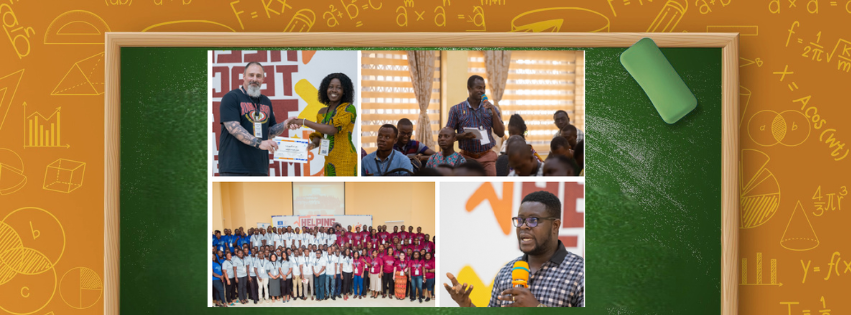
Helping Teachers Teach Mathematics Conference – HTTMC 2026
Bridging the Gap: Strengthening Africa’s Mathematics Classrooms Through Resilience, Innovation and Hope
One of the core objectives of AIMS Ghana, as a UNESCO Category II Centre of Excellence, is to support training and professional development in the mathematical sciences for high school teachers across Africa. In support of this goal, AIMS Ghana is working in partnership with the Centre for Education in Mathematics and Computing (CEMC) and the Pan-African Initiative for Research (PAIR), both at the University of Waterloo, Canada, to organize the Helping Teachers Teach Mathematics and Computing conference.
The conference is designed to give teachers across Africa the opportunity to deepen their understanding of key mathematical concepts in the high school curriculum, while also exploring practical and engaging ways to teach them. Sessions will focus on classroom-ready ideas and activities that teachers can take back to their students. More broadly, the conference aims to encourage reflection, collaboration, and the sharing of creative approaches to teaching mathematics and computing.
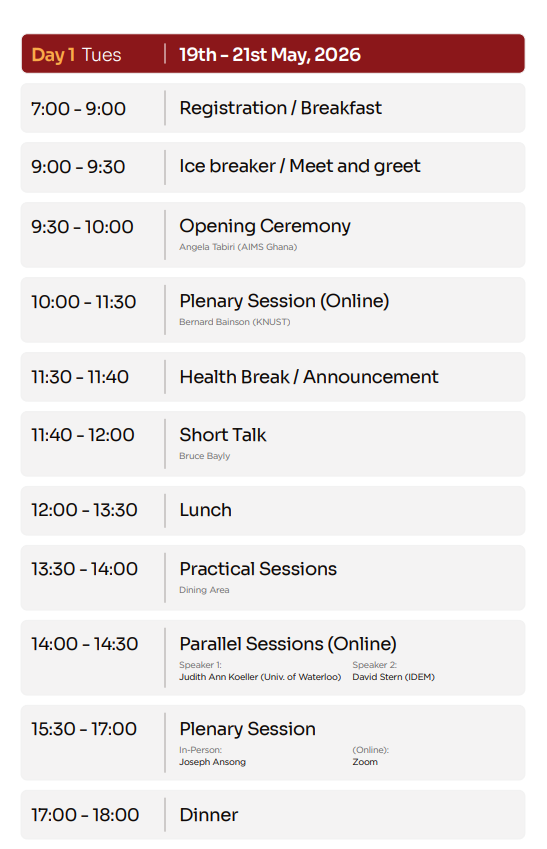
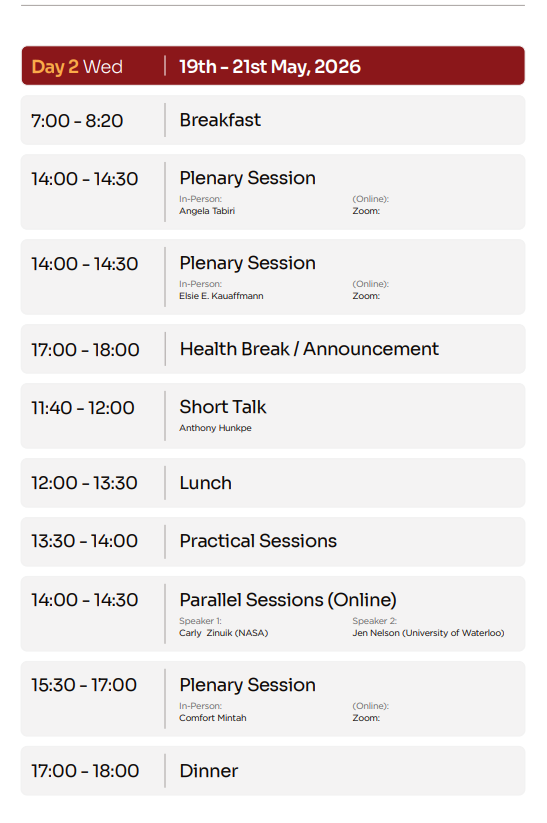
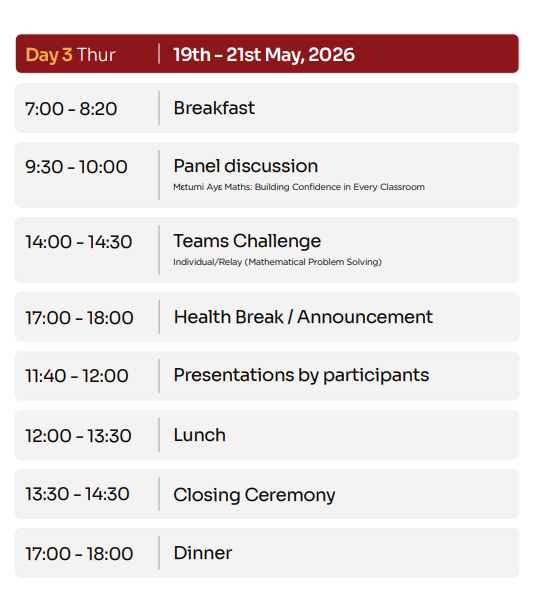
The fourth edition of the AIMS Ghana – CEMC Helping Teachers Teach Mathematics Conference (HTTMC) will take place at the University of Ghana from May 19 – 21, 2026. This blended (online and in-person) event will bring educators together to exchange ideas, build connections, and renew their enthusiasm for teaching mathematics and computing.
Helping Teachers Teach Mathematics Conference – HTTMC 2026 Organizers
Bridging the Gap: Strengthening Africa’s Mathematics Classrooms Through Resilience, Innovation and Hope

Helping Teachers Teach Mathematics Conference – HTTMC 2026 Application
Bridging the Gap: Strengthening Africa’s Mathematics Classrooms Through Resilience, Innovation and Hope
Who can apply:
We welcome applications from Mathematics and Computer Science teachers at the junior and senior high school levels (Grades 7–12) who are available to participate either online or in person.
Application Deadline: April 20, 2026
How to Apply:
Click HERE to complete the online application form.
If you have any questions, please contact us at httmc@aims.edu.gh.
Kindly include your full name and “HTTMC2026” in the subject line (e.g., Kwesi.Ofori.HTTMC2026).
Note: Only shortlisted applicants will be contacted.
Helping Teachers Teach Mathematics Conference – HTTMC 2026 Speakers
Bridging the Gap: Strengthening Africa’s Mathematics Classrooms Through Resilience, Innovation and Hope
jhh
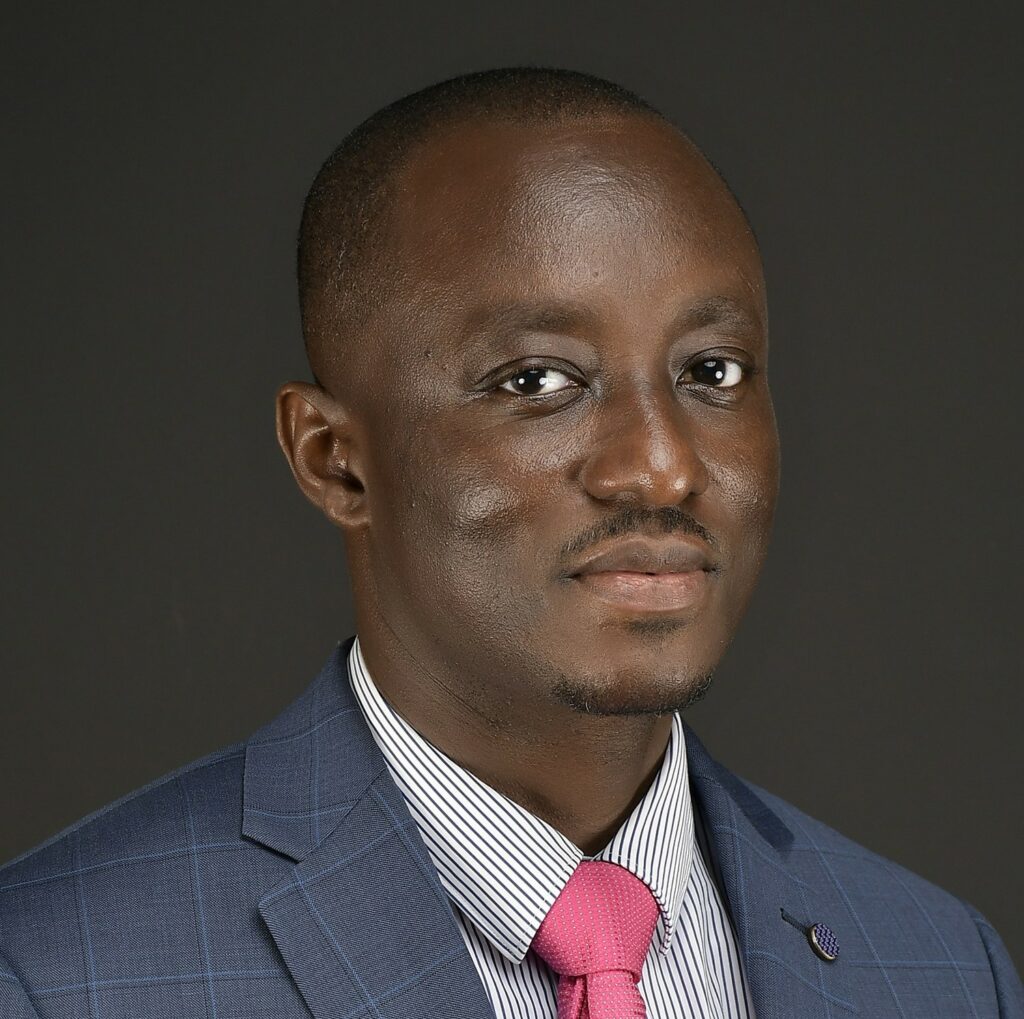
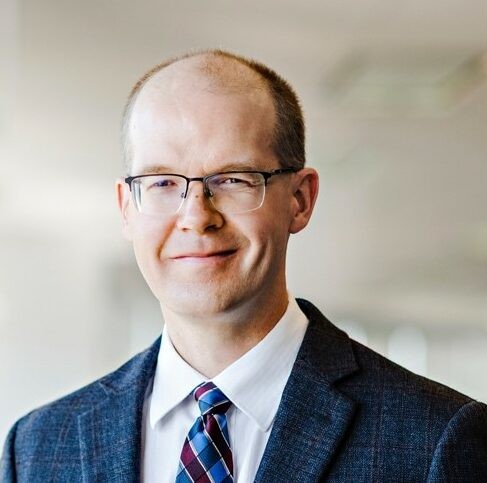
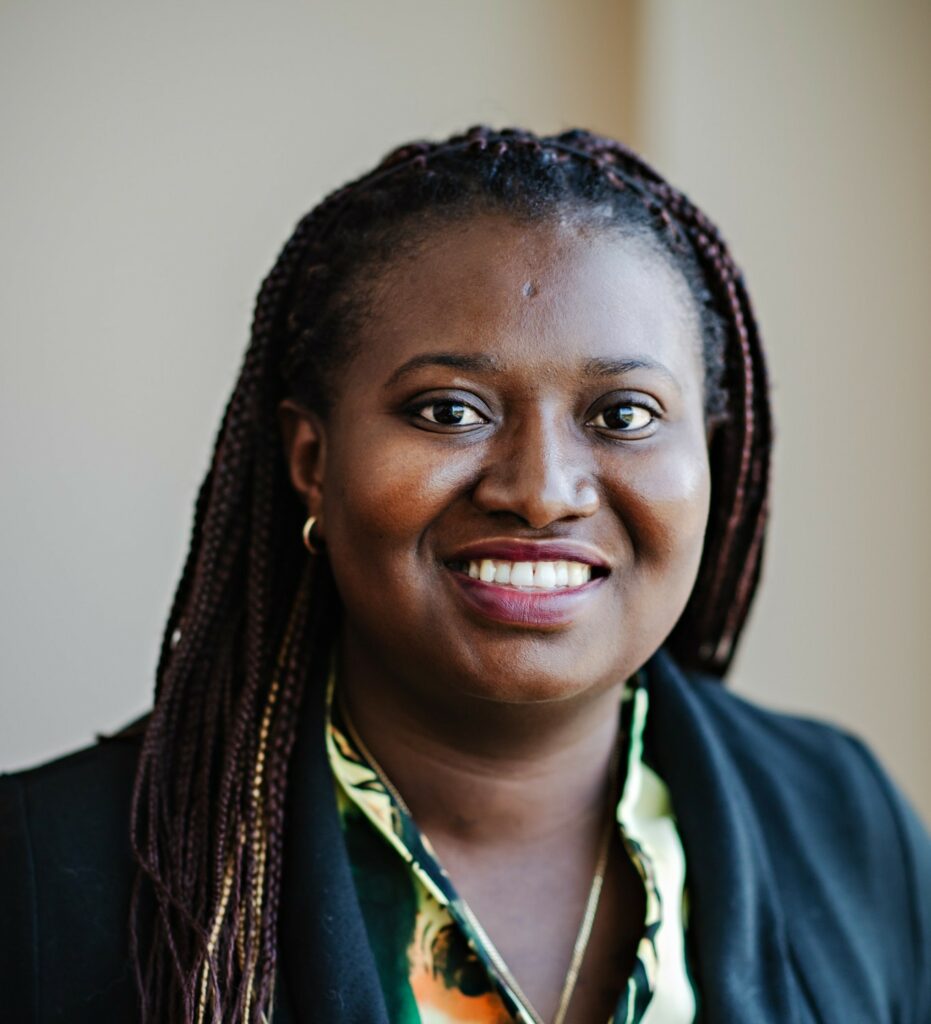
Meet the Speakers
Helping Teachers Teach Mathematics Conference – HTTMC 2026 Abstracts
Bridging the Gap: Strengthening Africa’s Mathematics Classrooms Through Resilience, Innovation and Hope
Abstracts
Carly Ziniuk
Title: Are Emojis Variables? Bridging the Gap between Visual Representation and Algebra
Abstract:
What if you could instantly hook your students on algebra by using the everyday emojis they already use? Through a series of visual puzzles, you will experience how to use engaging visuals—from seasonal-themed icons to sports pictograms—to help students intuitively grasp complex concepts like equation balancing, linear systems, and simplification. By developing their logical reasoning through these fun tasks first, students build mathematical resilience and naturally transition to using formal equations. Ultimately, they discover with confidence that traditional algebra can be a most efficient problem-solving tool. Plan to leave the session knowing how to quickly create these highly accessible tools for your students. Come learn how to implement these innovative strategies, and let’s help your students even design their own math challenges!
Judith Ann Koeller
Title: A Window from your Math Classroom to the World
Abstract
Try your hand at some mathematical problems with real-world applications, including planning more efficient routes, transmitting photos from space, saving lives through organ donations, and predicting future population numbers. We will see how these connect to high school curriculum topics, including polynomials, factorials and probability.
David Stern:
Title: Beyond bridging the gap. How African Innovation is potentially world leading!
Abstract
This session will present a series of experiences, from at least Ghana, Ethiopia and Niger, highlighting how innovation in the African context has created deep insights with global implications.
The session will then focus on a Kenyan innovation related to supporting teachers in implementing the Mathematics CBC (Competency Based Curriculum).
Finally, the session will conclude by presenting how these African innovations have the potential to become the foundation of human centered AI-Enabled education in world leading ways.
Comfort Mintah
Title: From “I Can’t” to “Let Me Try”
Abstract:
Too many students walk into mathematics classrooms already convinced they don’t belong. This talk begins with a simple idea: hope in mathematics starts the moment a learner decides to try. Drawing on work across Africa through HTTMC, CEMC Ghana school visits, and engagement with teachers and students in Ghana, Rwanda, and Kenya, the talk explores what truly shifts classrooms. Not big reforms. Not perfect conditions, but something smaller and more powerful. Because sometimes, the most powerful change starts with one quiet decision: “Let Me Try.”
Jen Nelson:
Title: Let’s solve some problems!
Abstract:
At its best, mathematics is all about the art of problem-solving. A good problem offers the opportunity to think carefully and systematically, as well as the chance to exercise creativity in discovering a path to the solution. In this session, we will experience these things for ourselves as we work through several interesting problems that could be used for discussion and enrichment in your classroom. Along the way, we will discuss problem solving tips to share with your students and other resources where you can find more problems to try out in your schools and classrooms.
Angela Tabiri
Title: The Algebra of Assessments: Investigating Isomorphisms in African High School Mathematics Education
Abstract:
This talk will be an interactive discussion with experiments, focused on using algebraic language to explore structure preserving maps in African mathematics classrooms. Participants will use digital tools and handouts to engage in the experiments. At the end of the session, participants will reflect on the exercises and propose new tools that will prove the proposed isomorphisms.
Joseph Ansong
Title: Rethinking WASSCE Preparation: Improving Outcomes While Promoting Deep Mathematical Understanding
Abstract
Many students who obtain excellent WASSCE Mathematics grades struggle when they transition to university-level mathematics. While they may perform well in examinations, many lack deep conceptual understanding, mathematical reasoning skills, and the ability to solve unfamiliar problems independently. This challenge is often linked to examination-driven teaching approaches that emphasize memorization and procedural mastery over understanding.
This presentation explores how SHS Mathematics teachers can prepare students effectively for WASSCE without sacrificing conceptual understanding. It highlights practical strategies such as teaching concepts before procedures, encouraging mathematical reasoning, using multiple representations, integrating Ghana-specific real-life examples, and fostering independent problem-solving skills.
The talk argues that strong examination performance and deep understanding are not competing goals, but complementary outcomes of effective mathematics teaching. The presentation advocates for a balanced approach that prepares students not only for WASSCE success, but also for meaningful engagement with mathematics beyond secondary school.
Elsie Effah Kaufmann
Title: Enhancing Mathematics Teaching Through Hands-On Modelling and Scale Reasoning
Abstract
This workshop is designed to support mathematics teachers in developing engaging, inquiry-based learning experiences that integrate geometry, measurement, and real-world applications. Participants will explore how hands-on modelling activities can deepen learners’ conceptual understanding and problem-solving skills.
The workshop centres on a task in which participants construct a scaled model of the Sun and Earth using a geometric structure known as a truncated icosahedron. Teachers will examine how this activity promotes connections between geometric properties (faces, edges, and vertices), spatial reasoning, and mathematical accuracy. Participants will also engage in analysing and correcting an incomplete model, promoting critical thinking and investigative skills in the classroom. A key component of the session focuses on scale and proportional reasoning. Teachers will work through calculations that translate real astronomical measurements into manageable classroom models, reinforcing core concepts such as ratio, unit conversion, and estimation. The workshop will highlight strategies for guiding learners to bridge abstract numerical relationships with tangible representations, enhancing both comprehension and retention.
Additionally, the workshop incorporates model-making using simple materials, demonstrating how low-cost, creative resources can transform mathematics lessons into interactive and meaningful experiences. Emphasis will be placed on facilitating learner collaboration, encouraging mathematical discourse, and assessing understanding through practical tasks.
By the end of the workshop, participants will be equipped with:
• Practical approaches to teaching geometry and scale using real-world contexts
• Techniques for integrating hands-on activities into mathematics instruction
• Strategies to promote inquiry, reasoning, and learner engagement
• Adaptable classroom resources aligned with curriculum objectives
This session ultimately aims to empower teachers to move beyond procedural teaching towards dynamic, experiential mathematics classrooms that inspire curiosity and deepen learning.
Bernard O. Bainson
Title: Opportunities of the African Mathematics Classroom
Abstract:
Mathematics Education in the African classroom analogous to many other subject learning has been acted upon by varying transformations over several decades. Examination of these maps present immediate properties including images and kernels portraying the merits and demerits of these changes over the years. This presentation, with the aid of these properties explores strategies, and emerging opportunities that when suitably adapted will make the mathematics classroom in Africa the space for nurturing resilient critical thinkers, innovators, technological, social and economic advancement leaders and the hope of a prevailing continent and the world at large. The role of the teacher in achieving these goals will be purposely highlighted.
Travel Guide
Routine Vaccines:
Be sure that your routine vaccines, as per your province or territory, are up-to-date.
Some of these vaccines include: measles-mumps-rubella (MMR), diphtheria, tetanus, pertussis, polio, varicella (chickenpox), influenza and others.
Pre-travel vaccines and medications:
You may be at risk for preventable diseases while travelling to this destination. Talk to a travel health professional about which medications or vaccines are right for you.
Diseases include:
Hepatitis A
Yellow Fever – Country Entry Requirements
Rabies
Measles
Hepatitis B
Polio
Influenza
Meningococcal disease
Malaria
COVID-19
Food and Water-borne Diseases
Travel health and safety:
Emergency medical attention and serious illnesses require medical evacuation. Medical services usually require immediate cash payment.
Make sure you get travel insurance that includes coverage for medical evacuation and hospital stays.
Prescription drugs
If you take prescription medication, you are responsible for determining its legality in Ghana.
Precautions
- Bring sufficient quantities of your medication with you
- Always keep your medication in the original container
- Carry a copy of your prescription(s)
- Pack them in your carry-on luggage
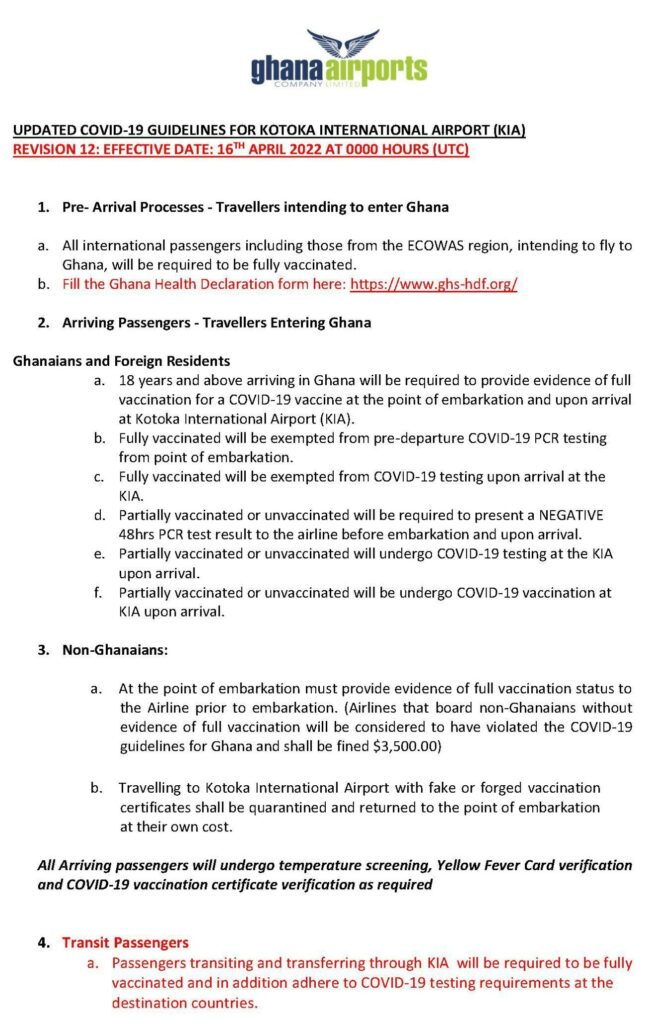
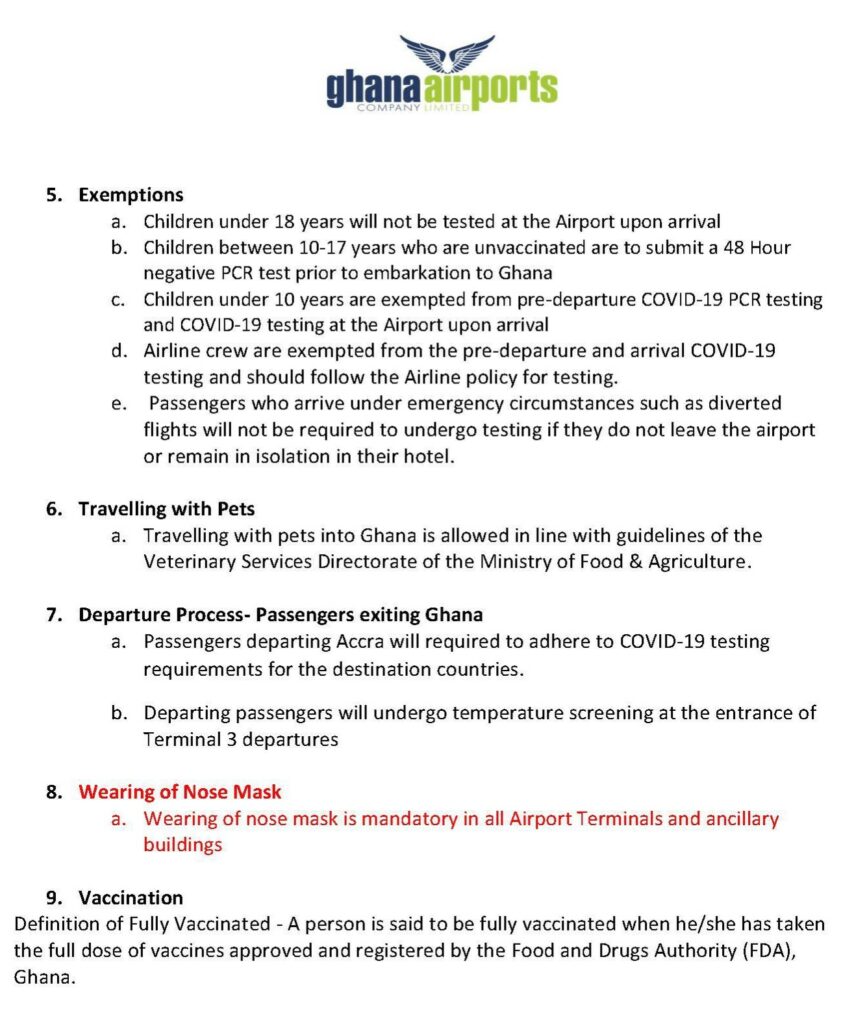
COVID-19 Protocol at AIMS Ghana
AIMS Ghana adopts recommendations from National Covid 19 guidelines, so the main protocol is that anyone visiting Ghana or the Centre is required to be fully vaccinated. All participants should kindly adhere to this protocol.


 English